WilliamLam.com

  • About
    • About
    • Privacy
  • VMware Cloud Foundation
    • VMware Cloud Foundation 9.1
    • VMware Cloud Foundation 9.0
  • VKS
  • Homelab
    • Hardware Options
    • Hardware Reviews
    • Lab Deployment Scripts
    • Nested Virtualization
    • Homelab Podcasts
  • VMware Nostalgia
  • Apple

VCF 9.1 - Quick Tip: Optimized Workflow for Configuring Distributed Transit Gateway (DTGW) with NSX Virtual Network Appliance (VNA)

08.11.2026 by William Lam // Leave a Comment

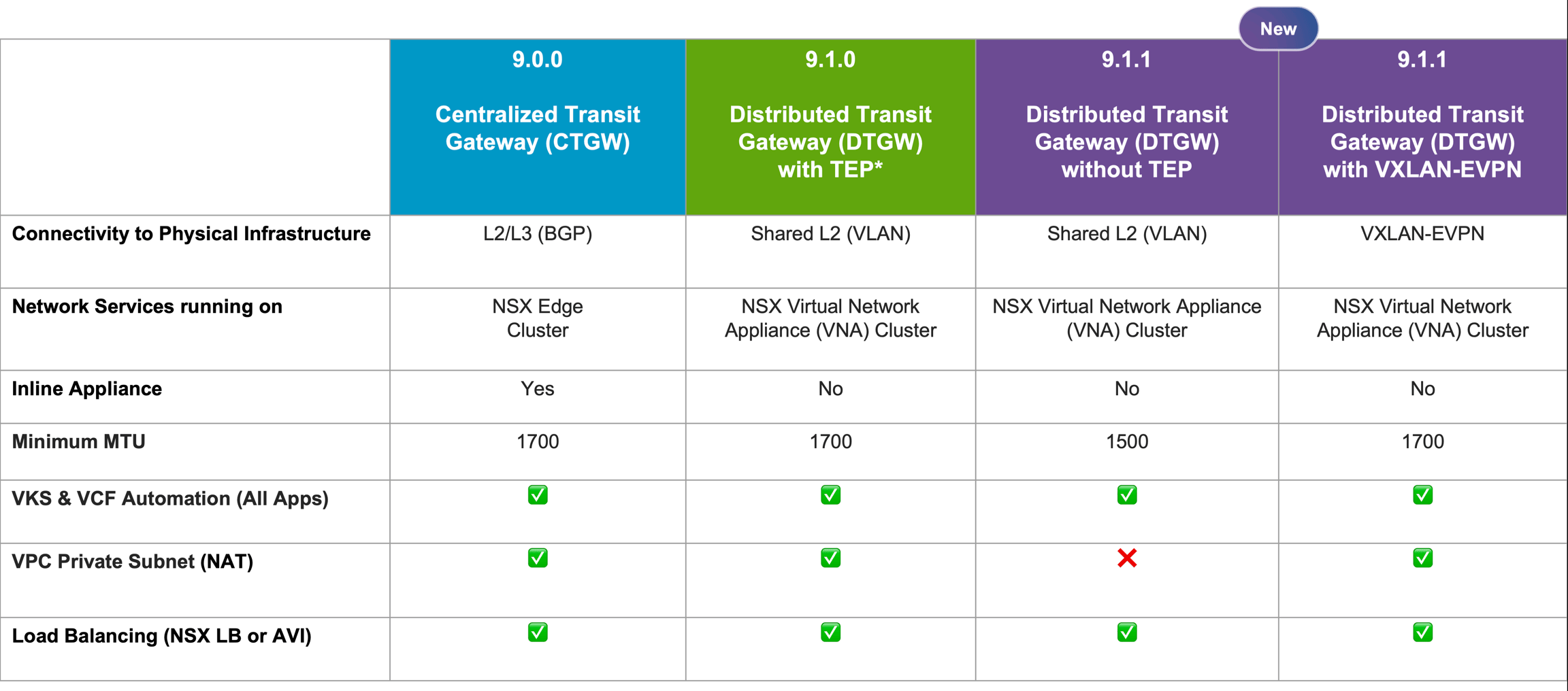
With VMware Cloud Foundation (VCF) 9.1, the Distributed Transit Gateway (DTGW) connectivity model now supports NSX stateful network services through the Virtual Network Appliance (VNA) cluster. This makes it easy for VI Admins to provision Virtual Private Clouds (VPCs), which can then be used to deploy vSphere Kubernetes Service (VKS) workloads using either vCenter Server or VCF Automation (VCFA).

One of the most underappreciated benefits is the ability to complete various NSX workflows including an entire VNA cluster deployment and DTGW configuration directly from vCenter Server, without having to switch to the NSX Manager UI. While NSX Manager still provides the underlying micro-frontend interfaces that are integrated into the vSphere UI, I appreciate having the flexibility to perform these workflows from either the vCenter Server or NSX Manager interface, depending on your roles and responsibilities within an organization.

While there are a number of community blog posts covering DTGW and VNA deployments, they typically start in the vSphere UI for the initial VNA deployment before switching to the NSX Manager UI to complete the remaining configuration, which is perfectly valid. Personally, I prefer using the vSphere UI for as many workflows as possible, especially since enabling vSphere Supervisor and vSphere Kubernetes Service (VKS) is also performed through the vSphere UI.

[Read more...]

Categories // NSX, VMware Cloud Foundation, vSphere Kubernetes Service, vSphere Supervisor

Quick Tip: Reducing High CPU Utilization on NSX due to slow Entropy from AMD Zen4/5 CPUs

07.31.2026 by William Lam // 2 Comments

AMD Zen4/Zen5 processors have been known to have slower entropy generation, which can lead to higher CPU utilization for workloads that depend on random number generation. I recently learned from a colleague (Ross Wynne) about a simple optimization for NSX Manager that can significantly reduce CPU utilization when running on AMD Zen4/Zen5 processors.

Shut down your NSX Manager VM and add the following VM Advanced Setting. This allows the guest operating system to retrieve entropy directly from the ESXi host, which already includes optimizations for entropy generation on AMD Zen4 and Zen5 processors.

isolation.tools.getEntropy.disable = FALSE


Note: Ensure you have applied the recommended entropySource configuration for your physical ESX host in addition to this configuration change.

In my limited testing, I have observed the NSX Manager load average drop to less than 5, whereas it was consistently much higher before applying this optimization. I will continue to monitor my environment, but this is definitely a worthwhile optimization to add to your VCF homelab toolkit. This configuration change can also benefit NSX Edge and NSX Virtual Network Appliances (VNA).

Categories // NSX, VMware Cloud Foundation Tags // VCF 9.0, VCF 9.1

Bypassing the ESX Tunnel Endpoint (TEP) 1600 MTU Check in the VCF Installer

01.29.2026 by William Lam // 2 Comments

Before deploying a new VMware Cloud Foundation (VCF) 9.0 environment, the VCF Installer performs a number of validations including network MTU. The minimum MTU that is required to deploy VCF is 1600, which is used for the Tunnel Endpoint (TEP) for NSX traffic between your ESX hosts.

For most environments, this is not an issue and users will typically deploy VCF with Jumbo Frames enabled and configure the MTU with value of 9000. If your environment does not meet the minimum MTU requirement, the VCF Installer will flag this as an error and prevent you from deploying as shown in the screenshot below.


If you can not meet the MTU requirement, you can bypass the validation check so that you can continue with your deployment of the VCF Management Domain.

[Read more...]

Categories // NSX, VMware Cloud Foundation Tags // VCF 9.0

  • 1
  • 2
  • 3
  • …
  • 22
  • Next Page »

Search

Thank Author

Author

William is Distinguished Platform Engineering Architect in the VMware Cloud Foundation (VCF) Division at Broadcom. His primary focus is helping customers and partners build, run and operate a modern Private Cloud using the VMware Cloud Foundation (VCF) platform.

Connect

  • Bluesky
  • Email
  • GitHub
  • LinkedIn
  • Reddit
  • RSS
  • Twitter
  • Vimeo

Recent

  • Quick Tip: Reducing High CPU Utilization in VCF Automation (VCFA) on AMD Zen4/Zen5 CPUs 08/12/2026
  • VCF 9.1 - Quick Tip: Optimized Workflow for Configuring Distributed Transit Gateway (DTGW) with NSX Virtual Network Appliance (VNA) 08/11/2026
  • Quick Tip: Selective ESX Host Patching in VCF 9.1 08/10/2026
  • Playing with Zero Touch Provisioning (ZTP) in vSphere 9.1 using an ASUS NUC 08/07/2026
  • Quick Tip: Automating ESX System Resource Pool Workaround Prior to 8.0 Update 3g 08/06/2026
Privacy & Cookies: This site uses cookies. By continuing to use this website, you agree to their use.

To find out more, including how to control cookies, see here: Cookie Policy

Copyright WilliamLam.com © 2026

Loading Comments...