WilliamLam.com

  • About
    • About
    • Privacy
  • VMware Cloud Foundation
    • VMware Cloud Foundation 9.1
    • VMware Cloud Foundation 9.0
  • VKS
  • Homelab
    • Hardware Options
    • Hardware Reviews
    • Lab Deployment Scripts
    • Nested Virtualization
    • Homelab Podcasts
  • VMware Nostalgia
  • Apple

Search Results for: VMware HCX API

Getting started with the Hybrid Cloud Extension (HCX) APIs

09.18.2018 by William Lam // Leave a Comment

VMware Hybrid Cloud Extension (HCX) is the de facto VMware solution when it comes to Enterprise scale workload migration whether that is from onPrem to onPrem or from onPrem to Cloud, including our VMware Cloud on AWS (VMC) offering. In fact, one of the most popular use cases for HCX right now is datacenter evacuation/consolidation and customers are migrating their workloads to VMC because they want to get out of the business of running datacenters and get back to running their core business. This is especially attractive for customers wanting to expand to new markets without requiring the need of new datacenters. This makes a ton of sense, especially when you go beyond the initial CapEx, its the on-going OpEx costs that folks may not always be thinking about immediately and being able to easily scale up or down is not always possible for most onPrem environments.

HCX already provides a rich UI interface within the vSphere Client for scheduling migrations including the new Cloud Motion with vSphere Replication feature which was announced at VMworld US 2018.


However, it should come as no surprise that our customers are also interested in Automation, especially as it can help expedite migrations and remove potential user error, especially around mapping the destination networks which can be quite daunting for a large number of migrations. The good news is that HCX provides a Restful API that allows customers to automate all aspects of HCX including the HCX VAMI UI for initial configuration as well as consuming the HCX services which are exposed in the vSphere UI.

[Read more...]

Categories // VMware Cloud on AWS Tags // HCX, Hybrid Cloud Extension, PowerCLI, VMware Cloud on AWS

How to unregister Hybrid Cloud Extension (HCX) from your onPrem vCenter Server?

09.17.2018 by William Lam // 1 Comment

I recently had to redeploy my Hybrid Cloud Extension (HCX) setup on my onPrem vCenter Server as a newer version had been released since the last time I had looked at this which was some time last year. I had already deleted my HCX Manager and cleaned up the other HCX VMs but one thing that is not handled for you currently are the extension plugins that HCX uses to register with vCenter Server, which is no different than any other solution that integrates with vCenter Server.

Today, the only easy way to unregister an extension is to use the vSphere MOB, which I have blogged about in the past here. As you can see from the screenshot below, HCX has a number of plugins and because this is done by hand, its entirely possible that you may accidentally unregister the wrong extension which could severely impact your vCenter Server.


To help reduce that risk, an alternative and recommended method is to simply use the vSphere API (which is exactly what the vSphere MOB is talking to) and specifying the specific extensions to unregister. Below is a quick PowerCLI snippet which talks to the vSphere API and unregisters the 8 extensions related to HCX. After this, if you are still logged into the vSphere Client, you simply need to logout and log back in for the UI components to go away. If you are still seeing the UI plugins, you may need to restart the vSphere Client service.

$extensionManager = Get-View $global:DefaultVIServer.ExtensionData.Content.ExtensionManager

$hcxExtensions = @(
"com.vmware.hybridity"
"com.vmware.hybridity.dr"
"com.vmware.hybridity.hcsp-dashboard"
"com.vmware.hybridity.publisher"
"com.vmware.hybridity.troubleshooting"
"com.vmware.hybridity.hybrid-interconnect-ui"
"com.vmware.hybridity.auditlog-ui"
"com.vmware.vca.marketing.ngc.ui"
"com.vmware.hybridity.mobility-app"
"com.vmware.hcsp.alarm"
)

foreach ($hcxExtension in $hcxExtensions) {
    $extensionManager.UnregisterExtension($hcxExtension)
}

Once the HCX extensions have been removed, you can now download the new HCX Manager appliance from the VMC portal and redeploy.

If you are still seeing the HCX Plugin in the vSphere UI after unregistering the extension, I have found that you also needed to clear the H5 Plugins on the vCenter Server itself. Here is what I needed to do to fully clean it up. Login to the VCSA and then run the following commands:

cd /etc/vmware/vsphere-ui/vc-packages/vsphere-client-serenity/
rm -rf com.vmware.hybridity*
rm com.vmware.vca.marketing.*
cd /usr/lib/vmware-vsphere-ui/server/pickup/
rm -rf com.vmware.hybridity*
rm com.vmware.vca.marketing.*

Categories // VMware Cloud on AWS Tags // HCX, Hybrid Cloud Extension, VMware Cloud on AWS

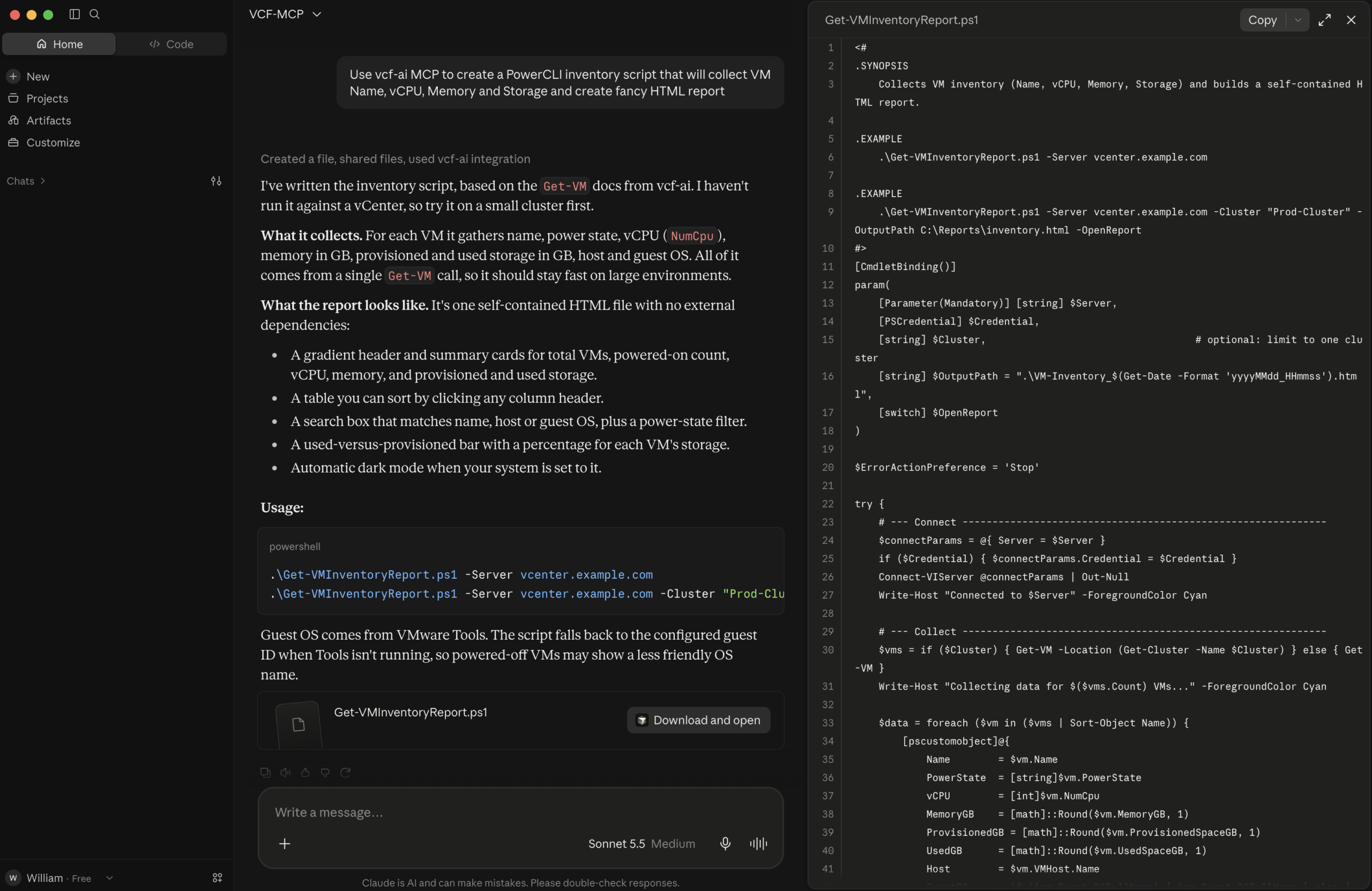
VCF Agentic AI Hub (Code Assist) MCP Server Fling

10.05.2026 by William Lam // 12 Comments

Creating scripts to help automate repetitive tasks or generate reports is a common need for every VMware administrator, and with Agentic coding tools like Claude Code, Codex, and Cursor, to name a few, the barrier to entry has been significantly lowered. In fact, when I spoke with attendees at VMware Explore Las Vegas 2026 about their use of coding agents, I saw a dramatic shift compared to the previous year, from maybe 20% to now over 80%!

However, one key challenge you may have experienced when using AI models (LLMs) is that they can still hallucinate and make up a non-existent REST API endpoint or PowerCLI cmdlet. LLMs are designed to always provide an answer, even when that answer may be wrong.

To help address this challenge and provide modern LLMs with the required VCF context for developing scripts and automation, a new Fling has just been released called VCF Agentic AI Hub (VCF-AI), which is delivered as a standalone virtual appliance. VCF-AI includes a VCF Code Assist MCP Server that currently supports code generation for the following VCF SDKs:

  • VCF PowerCLI
    • vCenter Server
    • vSAN
    • VCF Operations
    • SDDC Manager
    • NSX
    • vSphere Supervisor
    • HCX
    • SRM
  • VCF Python SDK
    • vCenter Server
    • vSAN
    • vSAN Data Protection
    • VCF Operations
    • VCF Installer
    • SDDC Manager
    • NSX
    • vSphere Supervisor
    • VCF Operations for Networks
    • Log Management
    • VCF Fleet and SDDC LCM

VCF-AI includes all the OpenAPI specifications and documentation for the two SDKs, which cover a number of VCF components along with skill files that have been created by VCF Engineering to allow users to easily create automation using their favorite Agentic coding agent.

[Read more...]

Categories // PowerCLI, VMware Cloud Foundation Tags // MCP, PowerCLI, python, VCF

  • « Previous Page
  • 1
  • 2
  • 3
  • 4
  • 5
  • Next Page »

Search

Thank Author

Author

William is Distinguished Platform Engineering Architect in the VMware Cloud Foundation (VCF) Division at Broadcom. His primary focus is helping customers and partners build, run and operate a modern Private Cloud using the VMware Cloud Foundation (VCF) platform.

Connect

  • Bluesky
  • Email
  • GitHub
  • LinkedIn
  • Reddit
  • RSS
  • Twitter
  • Vimeo

Recent

  • Major Enhancements to VCF 9.1 Upgrade Planner Tool 10/22/2026
  • VCF 9.1.1 - New UI Support for Deploying VCF Management Services (VCFMS) & VCF Automation (VCFA) on Non-Management Networks 10/19/2026
  • VCF Agentic AI Hub (Code Assist) MCP Server Fling 10/05/2026
  • Automate Inventory of vSphere Supervisor Clusters & vSphere Kubernetes Service (VKS) Guest Clusters 10/02/2026
  • VCF 9.1.1 - OCuLink External Graphics (eGPU) Dock with integrated PSU for GPU Passthrough with VKS 10/01/2026
Privacy & Cookies: This site uses cookies. By continuing to use this website, you agree to their use.

To find out more, including how to control cookies, see here: Cookie Policy

Copyright WilliamLam.com © 2026

Loading Comments...