WilliamLam.com

  • About
    • About
    • Privacy
  • VMware Cloud Foundation
    • VMware Cloud Foundation 9.1
    • VMware Cloud Foundation 9.0
  • VKS
  • Homelab
    • Hardware Options
    • Hardware Reviews
    • Lab Deployment Scripts
    • Nested Virtualization
    • Homelab Podcasts
  • VMware Nostalgia
  • Apple

Minimum vSphere edition & features for Tanzu Community Edition (TCE)

10.13.2021 by William Lam // 7 Comments

There have been a number of questions that have been raised by the community regarding the specific vSphere features and/or editions that is needed to deploy Tanzu Community Edition (TCE). I honestly thought I knew the requirements quite well myself but when it came to specific vSphere Editions, it made me second guess on what features TCE actually required for functionality.

I decided to deploy a brand new setup using the latest vSphere 7.0 Update 3 (vCenter Server and ESXi) release, which was all deployed onto a single 11th Gen Intel NUC. Below are my findings which I will share back with TCE folks and enhance our documentation. Ultimately, you just need access to a vCenter Server that is managing an ESXi host which can be a standalone host or one that is within a vSphere Cluster. Hopefully this will be helpful for anyone that wishes to get started.

vSphere Version:

  • As the official TCE documentation states, vSphere 6.7 Update 3 or newer is needed and this is primarily because that is the initial release that incorporates our vSphere CSI driver

vSphere Edition (minimum):

  • vCenter Standard and vSphere Standard
  • vCenter Essentials and vSphere Essentials Plus

Note: I did not have access to a vSphere Essential license but I am pretty confident it should also work.

vSphere Features:

  • Both vSphere HA and DRS is NOT required

Categories // VMware Tanzu, vSphere 7.0 Tags // Tanzu Community Edition

Integrated NSX-T deployment in vSphere 7.0 Update 3 fails with timeout

10.11.2021 by William Lam // 2 Comments

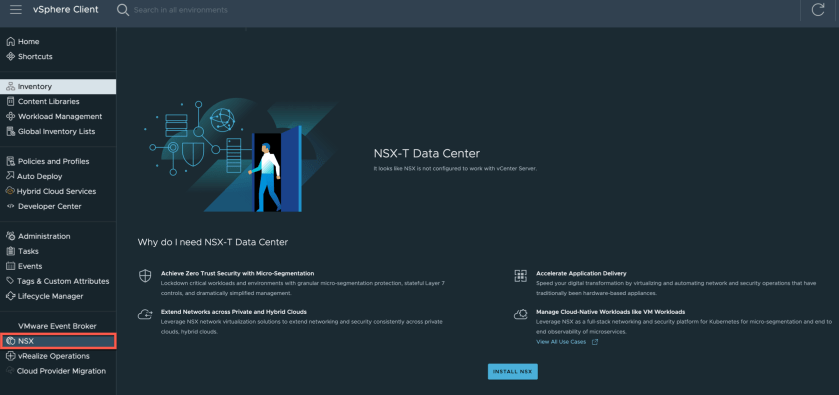
One of the new features highlighted in the latest vSphere 7.0 Update 3 release is the integrated NSX-T deployment and configuration workflow found directly within the vSphere UI as shown in the screenshot below.


After you click on the the "Install NSX" button, it will prompt for the NSX-T OVA and then take users through a guided wizard to on deploying and configuring NSX-T. I noticed that a few users were reporting a timeout issue after running through the workflow:

Cannot complete the operation: See the event log for details. Timeout: The task did not complete within the expected time span

I have not used this plugin before, so I was not sure what the issue was until I came across this Tweet from Validimir Velikov, a vSphere UI Engineer who had worked on the integrated NSX-T plugin and shared the reason for this error. A newer version of NSX-T will be needed to use this feature as the vSphere UI expects a "callback" from NSX-T Manager when the deployment and configuration is complete, which the current released version of NSX-T (3.1.3.1) does not support.

As discussed, current released versions of NSX-T don't support the vSphere integrated flow. A new NSX-T version should come shortly.
Otherwise, the flow expects a callback from the NSX Manager after deployment which never comes for old versions - hence, the timeout error. 😉

— Vladimir Velikov (@vladi_velikov) October 9, 2021

I think we could have provided a better user experience by first checking the NSX-T OVA version and ensuring that it meets the minimum version that supports this capability. Hopefully this is something we can improve upon in the future.

Categories // NSX, vSphere 7.0 Tags // NSX-T, vSphere 7.0 Update 3

How to programmatically retrieve vCenter Server Patch & Update History?

10.08.2021 by William Lam // 3 Comments

Homelab just upgraded successfully to vSphere 7.0 Update 3!

I really appreciate the “History” view to be able to see all the updates/patches that have been applied for your vCenter Server. Its the little things pic.twitter.com/Go9eicpeSp

— William Lam (@lamw.bsky.social | @*protected email*) (@lamw) October 7, 2021

After upgrading my homelab to the latest vSphere 7.0 Update 3 release, I was just looking at the "History" tab within the Virtual Machine Management Interface (VAMI), which gives you a historical view of all the patches and updates that have been applied to your vCenter Server since its initial deployment. I am not exactly sure when this was feature was introduced, but it can definitely be useful for both auditing but also debugging/troubleshooting purposes.

Of course, I was curious about this information and wanted to see if I could retrieve it using something like PowerCLI. However when I started to look for the API, I realized that there may not be a public API for this ... but that did not stopped me and taking a look at Chrome Developer, I quickly saw the endpoint which was /rest/appliance/update/history and I was able to figure out a workaround giving the same data.

Below are two examples on accessing this data using either PowerShell or cURL

[Read more...]

Categories // PowerCLI, vSphere 7.0 Tags // vSphere 7.0

  • « Previous Page
  • 1
  • …
  • 20
  • 21
  • 22
  • 23
  • 24
  • …
  • 42
  • Next Page »

Search

Thank Author

Author

William is Distinguished Platform Engineering Architect in the VMware Cloud Foundation (VCF) Division at Broadcom. His primary focus is helping customers and partners build, run and operate a modern Private Cloud using the VMware Cloud Foundation (VCF) platform.

Connect

  • Bluesky
  • Email
  • GitHub
  • LinkedIn
  • Mastodon
  • Reddit
  • RSS
  • Twitter
  • Vimeo

Recent

  • Quick Tip: Resolving OVFTool "Failed to Send File" Errors on macOS 06/13/2026
  • VCF 9.1 - Are You Using the Correct ESXCLI Command to Enable NVMe Tiering? 06/12/2026
  • VCF 9.1 - OCuLink External Graphics (eGPU) Passthrough with vSphere Kubernetes Service (VKS) 06/12/2026
  • VCF 9.1 - Quick Tip: Uninstalling Optional Day-N Components 06/11/2026
  • VCF 9.1 - Deploying VCF Operations for Networks to non-Management Network 06/10/2026
Privacy & Cookies: This site uses cookies. By continuing to use this website, you agree to their use.

To find out more, including how to control cookies, see here: Cookie Policy

Copyright WilliamLam.com © 2026

Loading Comments...