WilliamLam.com

  • About
    • About
    • Privacy
  • VMware Cloud Foundation
    • VMware Cloud Foundation 9.1
    • VMware Cloud Foundation 9.0
  • VKS
  • Homelab
    • Hardware Options
    • Hardware Reviews
    • Lab Deployment Scripts
    • Nested Virtualization
    • Homelab Podcasts
  • VMware Nostalgia
  • Apple

Create Windows 11 Virtual Appliance using Tiny 11 with only 2GB memory

02.15.2023 by William Lam // Leave a Comment

I recently came to learn about a really cool project called Tiny 11 which is a stripped down version of Windows 11 Pro 22H2 that can run with just 2GB of memory and 8GB of storage. While you would probably not use this for production workloads, it could be interesting for those with homelabs and can even for demo purposes.

It's finally here!
Based off of Windows 11 Pro 22H2, tiny11 has everything you need for a comfortable computing experience without the bloat and clutter of a standard Windows installation.
https://t.co/yM1Ip2ljjB pic.twitter.com/Tg5PWUZU1Q

— NTDEV (@NTDEV_) February 2, 2023

Disclaimer: Tiny 11 is not an official project from Microsoft, use at your own risk. If you are interested in creating an optimized Windows 10 or 11 image, you can also check out these VMware resources here and here to produce a similiar size image using official Microsoft tools and images.

UPDATE (02/16/23) - There is now an Arm version for Tiny 11, which is great for anyone using the ESXi-Arm Fling and the technique in this blog post would also apply.

? Updated Tiny 11 Arm64 (tiny11a64 r1.iso) now works perfectly with @esxi_arm ?

Thanks @NTDEV_ for the Arm version & quick fix!#ESXionARM pic.twitter.com/03TV69wMIq

— William Lam (@lamw.bsky.social | @*protected email*) (@lamw) February 16, 2023

After performing a manual installation of Tiny 11, I thought it would be neat if I could build a Virtual Appliance (OVA) for Tiny 11 and also add custom OVF properties, which would allow anyone to customize the OS further without having to rely on any external tooling.

In fact, I had demonstrated this concept back in 2019 using Windows Server 2016 in this blog post and I figure it should be easy enough to also do the same for Tiny 11 or even standard Windows 11! With a bit of trial/error, I was indeed able to create a simple Tiny 11 OVA that includes the following OVF properties as shown in the screenshot below.


My initial goal was to fully automate the building of a Tiny 11 OVA with custom OVF properties using Packer. However, after many attempts, I was not able to figure out the correct autoattended.xml configuration and decided on a semi-manual approach which is detailed in the instructions below. If anyone is able to figure out how to get Tiny 11 installed via Packer, then I may revisit this topic and automate the remainder of the setup.

Note: The instructions below are not specific to Tiny 11 in any way and is also applicable to standard Windows 10 or 11 image.
[Read more...]

Categories // Home Lab, OVFTool, PowerCLI, vSphere Tags // homelab, Tiny 11, virtual appliance, windows 11

Quick Tip - Additional NVMe vendors (SK Hynix & Sabrent) for ESXi homelab

02.13.2023 by William Lam // 12 Comments

The Samsung 980 Pro NVMe is a pretty popular SSD model that is used by many within the VMware Homelab Community. However, in recent months, there have been an alarming amount of reports from owners that their 980 Pro NVMe devices have been failing prematurely due to firmware issues.

Samsung Issues Fix for Dying 980 Pro SSDs https://t.co/BKoZgXE5Nk pic.twitter.com/J1eQfdp1eN

— Tom's Hardware (@tomshardware) January 31, 2023

Samsung has finally acknowledge the problem with a firmware fix and it looks like a simliar fix is also planned for the Samsung 990 Pro NVMe.

While I can not comment on the specific issues with the Samsung 980/990 Pro NVMe devices, I have had my own failures with cheaper Samsung M.2 NVMe devices where I lost my vSAN setup since I only had a single vSAN diskgroup comprised of single cache and capacity SSD for my homelab. While not ideal, this is to be expected since I had no redundancy and consumer hardware can and will fail over time. I ended upgrading both of my SSDs to a Samsung 970 Plus, which luckily is not affected by the firmware issues.

I typically recommend Samsung, Intel and Western Digital NVMe devices as they typically just work with ESXi, especially for homelab purposes where cost is one of the factors. From some of the online posts that I have read about the current Samsung 980/990 Pro issues, it seems that many have lost faith in Samsung and some have even stated that they will no longer consider Samsung for storage purchases.

This was also a simliar sentiment when I recently spoke with a fellow VMware colleague who was also impacted by the firmware issues. As part of our discussion, he had shared a couple of alternative vendors that he has is now using and recommending for his VMware Homelab setup which also includes vSAN. I thought this was good information that could also benefit folks in the community looking for other storage options.

[Read more...]

Categories // ESXi, Home Lab Tags // homelab, NVMe, Sabrent, Samsung, SK Hynix

How to bootstrap ESXi compute only node and connect to vSAN HCI Mesh?

01.31.2023 by William Lam // Leave a Comment

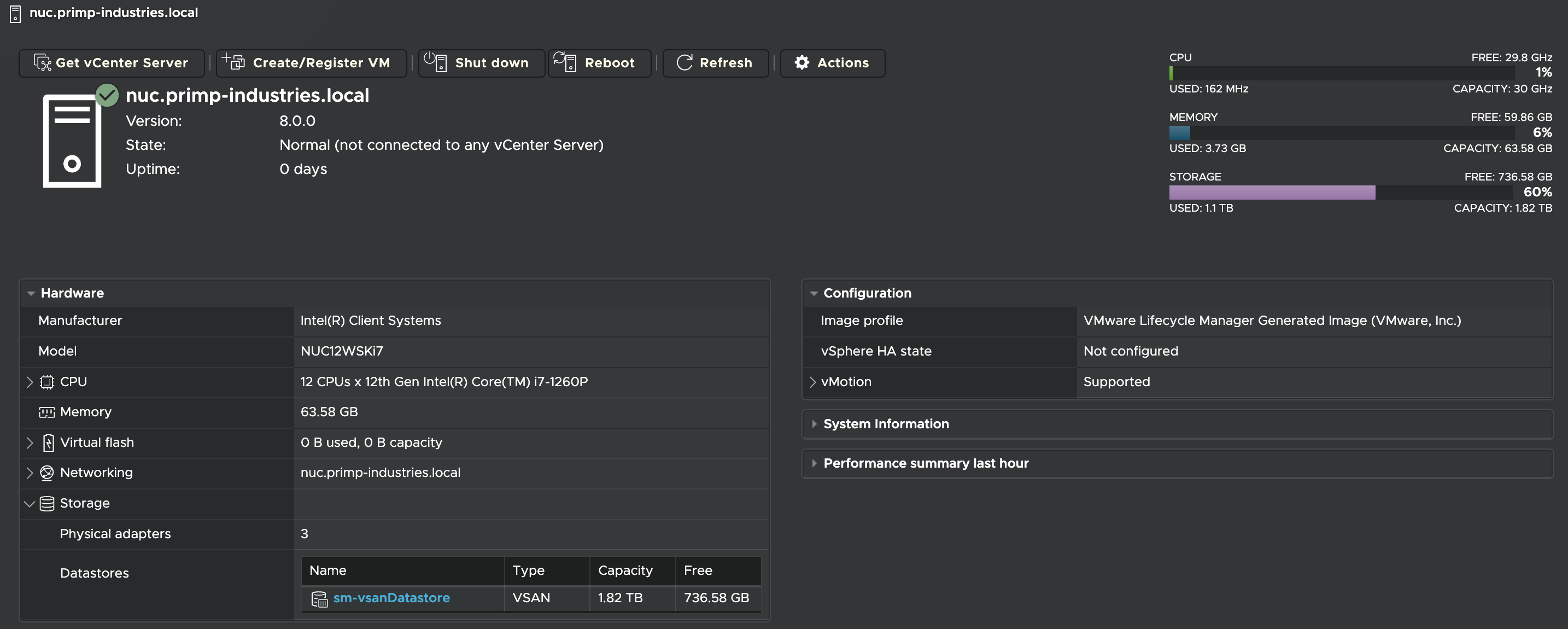
After documenting the process for bootstrapping vSAN Express Storage Architecture (ESA) using my Intel NUC 12 Pro, I was looking for an easier way to share my physical vSAN storage, which is powered by a single Supermicro E200-8D, to other physical ESXi hosts for testing purposes.

I had recently been playing with the vSAN HCI Mesh feature, which was launched back in 2020, as I was running out of spare NVMe devices when needing to test different physical hardware kits. While my use case for the storage is typically short lived, it means I do not have to play musical chairs with the limited number of NVMe devices I have installed in the various kits I have.

The vSphere UI in vCenter Server already provides a very simple workflow to mount a remote vSAN storage on an ESXi compute-only node, but I was also looking at this from a bootstrapping point of view and what if vCenter Server was not deployed or even available? Could I still make this work? After a bit of trial and error, I was able to figure out this can be accomplished by using a series of ESXCLI commands!

[Read more...]

Categories // ESXi, Home Lab, VSAN, vSphere 7.0, vSphere 8.0 Tags // Express Storage Architecture, HCI Mesh, VSAN, VSAN 8

  • « Previous Page
  • 1
  • …
  • 17
  • 18
  • 19
  • 20
  • 21
  • …
  • 57
  • Next Page »

Search

Thank Author

Author

William is Distinguished Platform Engineering Architect in the VMware Cloud Foundation (VCF) Division at Broadcom. His primary focus is helping customers and partners build, run and operate a modern Private Cloud using the VMware Cloud Foundation (VCF) platform.

Connect

  • Bluesky
  • Email
  • GitHub
  • LinkedIn
  • Reddit
  • RSS
  • Twitter
  • Vimeo

Recent

  • VCF 9.1.2 - ESX Kickstart using vSphere Configuration Profiles (VCP) 11/25/2026
  • Quad-Port Remote KVM Upgrade for my VCF Lab 11/20/2026
  • vCenter Linking Replaces Enhanced Linked Mode (ELM) in VVF & VCF 9.x 11/18/2026
  • VCF 9.1.x Upgrade Sequence with Shared NSX Manager 11/17/2026
  • Quick Tip - How to Manually Verify VCF Software Download Checksums? 11/09/2026
Privacy & Cookies: This site uses cookies. By continuing to use this website, you agree to their use.

To find out more, including how to control cookies, see here: Cookie Policy

Copyright WilliamLam.com © 2026

Loading Comments...